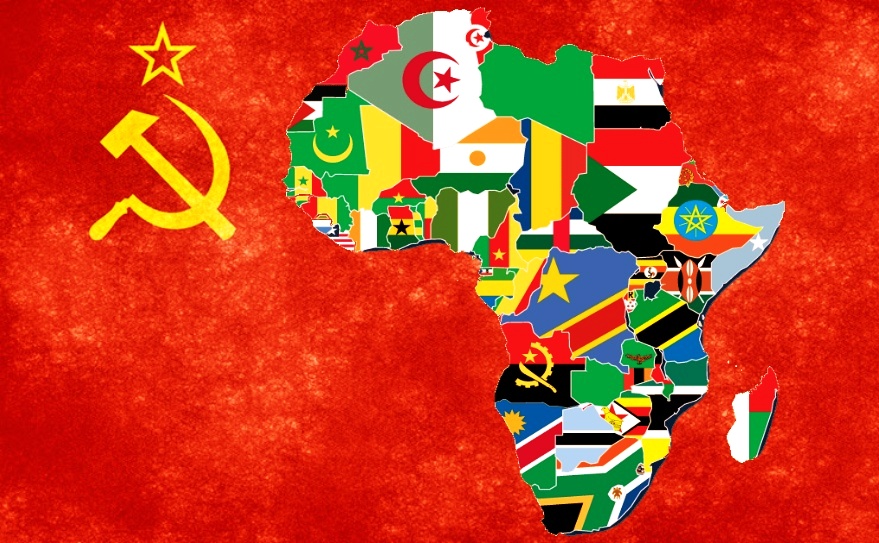

The Socialist Movement is largely led by white cis-gendered men, which makes it no surprise why Africa’s history of socialism is unhighlighted, ignored and forgotten. Here are 5 African countries with socialist history to begin your research into what we’re calling, Afro-communism.
- The People’s Republic of Benin

Prior to the Republic of Benin, Benin’s economy had largely been controlled by France and international organisations, resulting in economic stagnation and low standards of living.
On the 26th October 1972, President Justin Ahomadegbé-Tomêtin (then president of the Republic of Dahomey) was removed from presidency in a coup d’état led by Major Mathieu Kérékou. Initially, Kérékou opposed capitalism, socialism and communism, and vowed to input the Dahomean social and cultural system; nationalism. In 1975, Kérékou declared himself a Marxist-Leninist and the state would also follow the ideology, thereby the Dahomean state was renamed the People’s Republic of Benin (after the Kingdom of Benin, Nigeria). This move was potentially driven to gain support from Beninese socialists as well as the Soviets, also to promote national unity. Benin became a one-party state in 1975 as the People’s Revolutionary Party of Benin was the only legal party.
In theory, the economic situation had become more diverse and efficient, however, corruption still existed and the overall economic situation had not improved. It was not long before Kérékou started to nationalise the banks and the oil industry. In the mid 80s, attempts at liberalising the economy had also failed to boost the economic situation. In the late 80s, Kérékou resorted to free market reforms and public, health care, and government service cuts. By the early 1990s, along with changes to the constitution, all elements of Marxism were erased and total economic privatisation began. In 1989, other parties were allowed to run for government, and in 1991, Kérékou was out of office.
Benin was the only west African country to declare itself as Marxist-Leninist and the first African country to make a post-cold war transition away from Marxism-Leninism.
- The People’s Republic of the Congo

In 1963, the openly Marxist Alphonse Massamba-Débat became president of the Republic of the Congo. In 1964, Massamba-Débat was a member of the National Revolution Movement political party, in which he instilled a single-party system. Défense Civile was a popular militia who backed the National Revolution Movement party. In 1966, one of the leaders, Captain Marien Ngouabi, protested against the militia’s inflexibility in politics and heavily criticised President Massamba-Débat, which led to his demotion in rank. On July 29th 1968, the president imprisoned Ngouabi.
On July 31st 1968, Ngouabi was freed from prison by soldiers from Défense Civile after the president announced an amnesty to political prisoners. In September 1968, Massamba-Débat gave up his presidency, leading to instability in the government.
On August 5th 1968, the National Revolutionary Council led by Ngouabi was created, in October Ngouabi was promoted to the rank of Commanding Officer. On December 31st 1968, Ngouabi became Head of State following the National Revolutionary Council becoming the supreme authority of the country. Ngouabi renamed the country the People’s Republic of the Congo, the first Marxist-Leninist state in Africa. Alongside this, he founded and declared the Congolese Workers’ Party the only political party, making the People’s Republic of the Congo a single-party state.
Ngouabi introduced various communist policies such as nationalising the means of production. Tensions between the party and the people began due to Ngouabi being from the north which shifted control away from the south of the country. Tensions within the party began due to bureaucratic centralism, tribalism to Mboshi and La Cuvette immigrants and various other internal issues, which created particular opposition with the party’s youth organisation.
On 18th March 1977 Ngouabi was assassinated. Former president Massamba-Débat was one of the accused assassins who was tried and executed for Ngouabi’s death. An interim government was established following the assassination, with Colonel Joachim Yhombi-Opango as Head of State. In 1979, the interim government ended with Denis Sassou-Nguesso rising to presidency.
The People’s Republic of the Congo maintained close relationships with both the Soviet Union and France. In 1991, the Sovereign National Conference renamed the country back to the Republic of the Congo, replaced the flag and anthem, and ended the Congolese Workers’ Party government.
- The People’s Democratic Republic of Ethiopia


Previously, Ethiopia was a feudalistic state ruled by Haile Selassie I, Emperor of Ethiopia from November 1930 to September 1974 until he was deposed by the Provisional Military Administrative Council, or the Derg. The Derg was a military junta – a nonideological, unelected committee of the military and police. In November 1974, 60 government and military officials, as well as the leader of the Derg, were executed; this was called the ‘Massacre of the 60’ or ‘Black Saturday’. In March 1975, the new Derg led by Chairman Tafari Benti abolished the monarchy, declared Ethiopia as a Marxist-Leninist state, and established the Derg as the vanguard party for the interim government.
The first policies included: abolishment of feudalism, increase literacy rates, nationalisation of the means of production, and extensive land reform. Following internal conflict, multiple executions took place of the current Chairman Benti, his supporters, and the vice-chairman. In November 1977, leadership fell to Mengistu Halie Mariam who ran uncontested.
While Ethiopia was suffering from instability, drought and a significant refugee crisis, in 1977 Somalia (who previously was using USSR arms and supplies) invaded Ethiopia in the Ogaden War. Due to military aid from Cuba, East Germany, North Korea, USSR and South Yemen, Ethiopia was able to recover.
In 1976 to 1978, the Derg’s ‘Red Terror’ campaign against opposition groups, such as the Marxist-Leninist Ethiopian People’s Revolutionary Party, was a response to the ‘White Terror’ of petty bourgeois reactionaries who protested for a 1974 revolution reversal. 500,000 people were killed.
Now Ethiopian leader, Mengistu, nationalised land ownership to the state in the Land Reform Proclamation of 1975. This provided at most 25-acre allotments to peasants who farmed the land themselves. Mengistu also completed full nationalisation of the means of production and the economic base of the old ruling class. Consequently, due to the lack of incentive, small allotments, and intense drought, farmers could not meet the ideal yield of crop. In 1984, famine swiftly ensued. The 1983 to 1985 Ethiopian famine killed 1 million people and effected 8 million.
In 1984 the Worker’s Party of Ethiopia was formed with Mengistu as Secretary General. In 1987, the Derg self-dissolved and upon the ratification of the 1987 Constitution of Ethiopia the new government renamed the country the People’s Democratic Republic of Ethiopia, with Mengistu as president.
During this time, Gorbachev changed course away from international communism, resulting in reduced assistance to Ethiopia. This dominoed to Ethiopia facing economic difficulty and military collapse whilst dealing with the upcoming guerrilla tactics from Eritrean and Tigrayan regions wanting independence. Mengistu implemented a mixed economy and hindered the one-party rule which ended Ethiopia’s Marxist-Leninist state.
- The People’s Republic of Angola

In 1975, the People’s Republic of Angola became independent from Portugal due to the Alvor Agreement, and shortly after made alliances with the USSR, Cuba, and the People’s Republic of Mozambique. Leading the country was the People’s Movement for the Liberation of Angola (MPLA), an anti-Portuguese and anti-American group which vowed for a Marxist-Leninist one-party state.
This new government led by president António Agostinho Neto, and president José Eduardo dos Santos in 1979, aimed to improve adult literacy and education. In 1986, over 1.5 million students were in primary school, 500,000 adults were literate, also local African languages were introduced into primary schools as Portuguese was mostly spoken. Considering that Angola had faced colonialism and civil war, the people living in the People’s Republic of Angola maintained a commendable standard of living. The profits from trades with their Eastern bloc allies were distributed to the people, and Cuba provided medical supplies and doctors to support the growing healthcare sector.
The National Union for the Total Independence of Angola (UNITA) was led by Jonas Savimbi and initially fought alongside the MPLA for independence. After 1975, the UNITA, backed by the US and apartheid South Africa, established the Democratic People’s Republic of Angola as the true legitimate country, as opposed to the People’s Republic of Angola. A civil war thereby ensued between the two self-proclaimed governments.
The civil war in Angola lasted from 1975 to 1991 when the MPLA and UNITA signed the Bicesse Accords peace agreement. This agreement required Angola to become a multi-party liberal democracy.
- The People’s Republic of Mozambique


Pre revolution, Mozambique had a highly privileged White elite and an incredibly poor Black working class. The majority lacked healthcare, women’s rights and had poor literacy rates. The Mozambique Liberation Front (FRELIMO) was a socialist organisation who fought colonisation in Mozambique.
In 1975, the People’s Republic of Mozambique received independence from Portugal, and became a one-party socialist state under the new Frelimo Party, led by Samora Machel. They implemented a voluntary democratic education programme, although not the best due to lack of funding and resources, illiteracy rates dropped from 90% to 72.2% by 1980.
Interestingly, gender equality improved due to great efforts by the party to encourage women into male-dominated jobs, mainly in government and production. However, due to the history of traditional patriarchy in society, the household roles failed to equalise. The People’s Republic of Mozambique took out of their limited resources to support the women’s organisation, and guaranteed that the development aid was shared with women. Compared to antisocialist states, women received greater economic support and it was the one of the best in Africa.
The Frelimo party also aimed to better Mozambique’s agriculture, firstly by ending forced cropping and introducing family and state farms. However, due to low-budgets causing lack of equipment, warfare, drought, unrealistic production targets, and the need for voluntarism, farming co-operatives struggled. In 1983, family farming also faced difficulties. The Frelimo party instilled unnecessary policies which meant the farmers could not exchange their products for goods. Following this, the party began to capitalise their agriculture sector in an attempt to encourage an increase in production, private farms became main beneficiaries. By the late 1980s, the agricultural problems reached an all-time high, most of which was exacerbated by antisocialist aggression.
In 1977, a civil war broke out between FRELIMO (and the Armed Forces of Mozambique) and the Mozambique Resistance Movement (RENAMO). FRELIMO received military aid and support from the USSR and later France, the UK and US. RENAMO received military aid and support from Rhodesia (Zimbabwe), South Africa, Kenya, organisational support from West Germany, and support from the conservatives in the US (until reports of RENAMO’s crimes against humanity came to light). Malawi gave support to both by using Malawi Young Pioneers to support RENAMO and the armed forces to back FRELIMO. By the end of the 1980s, the civil war reached a stalemate. In 1990, direct talks between both FRELIMO and RENAMO began, leading to FRELIMO’s July 1989 draft constitution calling for a multi-party system, this was instilled in November 1990.
 Welsh Underground Network